30 September 2026 | Awniraya Logistik
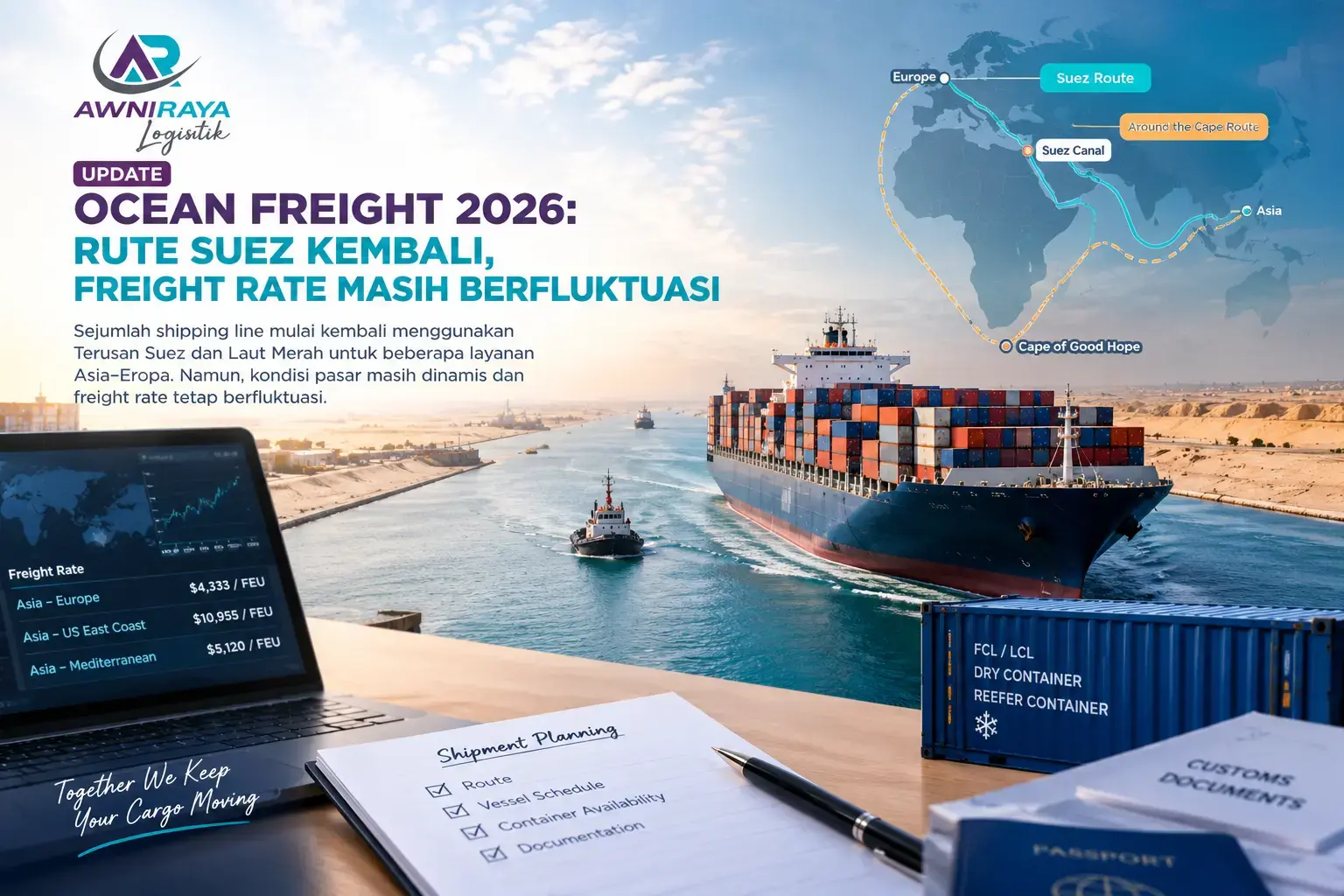
The latest developments in the ocean freight industry indicate changes in the global shipping network. A number of shipping lines have begun to return to using the Suez Canal and Red Sea for several Asia-Europe services after previously many ships were diverted via the Cape of Good Hope due to security conditions in the region.
The return of some routes via Suez has the potential to cut transit times compared to circuitous routes through Africa. However, this condition does not mean that the entire shipping network has returned to normal. Shipping lines are still making selective route adjustments because the security and operational situation is still dynamic.
Impact for Exporters & Importers
Changes in routes can affect:
Freight rate
Transit time
Vessel schedule
Port congestion
Surcharge and costs operations
Availability of containers
Market data for September shows that freight rates are still at high levels on a number of routes. Xeneta, for example, noted that on September 10, 2026 the average Far East–North Europe spot rate was around US$4,333/FEU, while Far East–US East Coast reached US$10,955/FEU.
On the other hand, increased use of the Suez route is starting to put pressure on some Asia–Europe rates. Drewry data reported on September 24 showed the World Container Index fell 1% weekly to US$4,468 per 40-foot container, although it was still much higher than the same period the previous year.
What does this mean for customers?
For exporters and importers, this condition makes shipment planning even more important.
Vessel selection, route, departure schedule, type containers, as well as document readiness need to be considered from the start.
For frozen seafood and fishery products cargo, planning also needs to pay attention to the availability of reefer containers and cargo temperature control during the journey.